Build your strength.
Support muscle growth and repair, alongside resistance training and recovery.
MOVIVA / Minimum viable vitality
The smallest practical meal base that supports a life of strength, energy and vitality. Build your foundations, then add the energy your goals need.
A note from Striker
Hi, I’m Striker. I spent four years exploring how NASA astronauts are fed, how athletes eat at institutes of sport, and how bodybuilders approach a cut while trying to preserve muscle.
That curiosity became MOVIVA: minimum viable vitality. My idea is simple: craft a set of everyday meals that supports the foundations of a strong, energetic life. Start with a compact meal base. Plan it ahead. Add to the base when growth is the goal.
The MOVIVA framework
Support muscle growth and repair, alongside resistance training and recovery.
Essential fatty acids, normal body function, and absorption of fat-soluble vitamins.
Support regularity and provide food for beneficial gut microbes.
Fermented foods reduced inflammatory markers in a small human trial. Possible mood benefits remain under investigation.
01 / The method beside the evidence
0.5 g/kg per meal
Four meals give 2 g/kg/day. MOVIVA uses this as its muscle-focused planning target. Count the whole day, then distribute it across meals.
How the recommendations compare
Floating columns show recommended ranges. These references serve different populations and goals; higher does not automatically mean better. MOVIVA is a chosen planning target, not an agency recommendation.
These recommendations address different populations. Four meals are the method’s structure; 0.5 g/kg is not an absorption ceiling. Protein-dose study
0.2 g/kg per meal
Four meals give 0.8 g/kg/day. This is MOVIVA’s chosen starting rule. Count the fat already in meat, fish, eggs and dairy before adding oil; favour predominantly unsaturated sources.
What the testosterone studies establish
Human feeding studies show that changing a diet can change some testosterone measurements. Their results do not establish 0.8 g/kg/day as a universal hormone optimum.
| Study | Diet / grams | What changed |
|---|---|---|
| Dorgan 1996 43 men, crossover | 3,170 kcal/day; 18.8% vs 41% fat. 66.2 vs 144.4 g/day calculated. | Total testosterone mean +13% on the higher-fat/lower-fibre diet; abstract reports significance for SHBG-bound testosterone, not total. Fibre and fat composition differed. |
| Wang 2005 39 men, age 50–60 | 2,627 vs 2,597 kcal/day; 37.9% vs 13.9% fat. 110.6 vs 40.1 g/day calculated; directly reported fat 111.7 vs 40.1 g/day. | Total testosterone 16.9 → 14.9 nmol/L (P=.0001) after eight weeks on the lower-fat/higher-fibre diet. Body weight also fell about 1 kg. |
| Hämäläinen 1984 30 men | 40% → 25% fat; isocaloric. Daily kcal not verified, so no grams inferred. | Total testosterone 22.7 → 19.3 nmol/L (P<.001); fat type changed too. Values returned after resuming the customary diet. |
Conversion: average kcal/day × fat fraction ÷ 9. Products of group means can differ from the study’s directly reported mean grams. These comparisons do not isolate fat from other dietary changes.
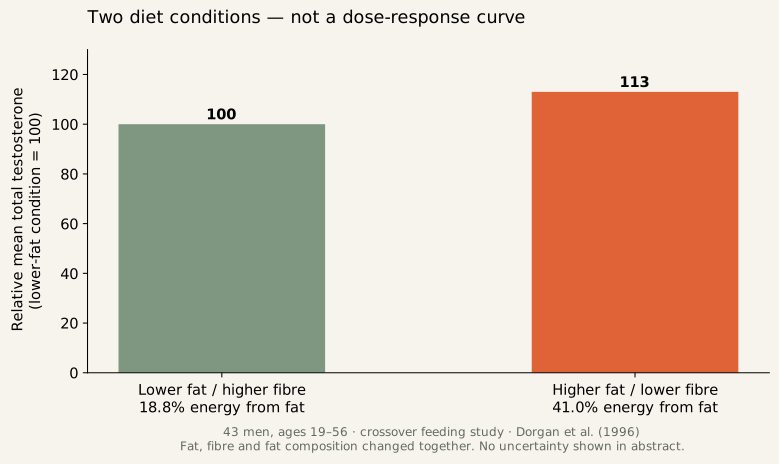
Mean total testosterone was 13% higher on the higher-fat/lower-fibre diet; the abstract reports statistical significance for the SHBG-bound fraction, not total testosterone. Relative means shown without uncertainty, which the abstract does not supply. Two conditions cannot reveal a peak or a high-intake decline.
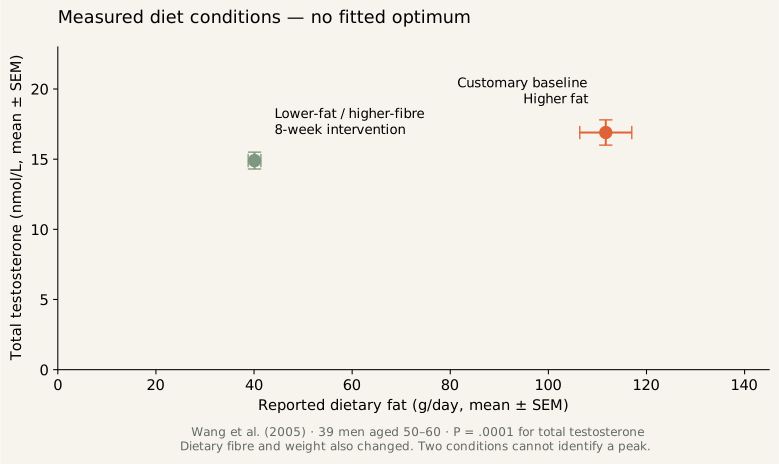
Observed means ± SEM, 39 men; lower-fat intervention versus customary baseline. X error bars are reported fat-intake SEM. Fibre and body weight changed too. Author’s full paper, Table 1 and Figure 3.
Dietary fat intake and stored body fat are different exposures. These studies do not establish an optimum at 0.8 g/kg/day or a daily-fat rise-then-fall curve. Even when lower fat lowered testosterone, that did not demonstrate improved vitality or libido at a particular intake.
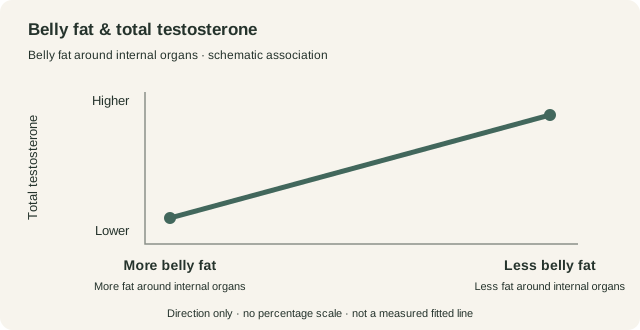
30 g/day · adult male reference
Build variety into your plant foods. Increase fibre gradually and find portions that suit your digestion. Fibre stays part of the base when your energy budget changes.
Reference, not a body-weight formula
Australian adult adequate intakes are 30 g/day for men and 25 g/day for women. The US reference uses 14 g per 1,000 kcal; MOVIVA’s 15 g is a rounded planning comparison. Neither establishes a universal 0.45 g/kg requirement.
Australian fibre reference · US fibre referenceOptional
Yogurt, kefir, kimchi and sauerkraut bring flavour and variety. A small human trial found that a diet rich in fermented foods reduced inflammatory markers and increased gut-microbe diversity. Choose live-culture foods you enjoy.
Inflammation: the measured results
In a study of 36 healthy adults, 18 followed the fermented-food diet. Over the 10-week ramp-up and maintenance intervention, researchers found decreases in 19 of 93 measured serum proteins involved in immune signalling, including IL-6, alongside increased gut-microbe diversity.
This counts markers that decreased; it is not a percentage reduction in inflammation. A small trial of biological markers does not establish disease prevention or the same benefit from every fermented food.
Wastyk and colleagues, Cell (2021), Figure 6A · Stanford’s study summary
Your gut and brain communicate through nerves, immune signals and microbial chemicals. Some trials of specific probiotic supplements suggest mood benefits. In one 49-person pilot trial, a multistrain probiotic taken alongside antidepressants produced promising changes on some symptom measures.
Mood findings remain mixed and product-specific. Probiotic supplements and fermented foods are not interchangeable; these results do not establish that fermented foods improve mood or replace treatment. Read the pilot trial · The gut–brain connection.
4 planned meals
Start with the protein, fat and fibre base. Add carbohydrate portions for training, maintenance or gaining mass, guided by your total energy needs.
Cut · maintain · gain
Cut: Use the minimum MOVIVA meal base to help cut body fat, with portions that leave you eating less energy than you use.
Maintain: Add carbs to the base and adjust portions until your weight stays steady over time.
Gain: Add more carbs or more meals per day to support muscle gain alongside resistance training. Prefer a bodybuilder-style routine? Spread your daily food across six meals like these, adjusting portions to your needs. Track weight and strength and adjust gradually.
Rice, oats, potatoes and fruit can help fuel activity. Chocolate or ice cream can fit for enjoyment, with their fat and energy counted too. The base targets are starting points; needs can change with the person and training.
Make food decisions ahead of time. Choose your meals, buy the ingredients, batch cook, and keep portions ready in the fridge or freezer. On the day, follow the plan.
Make the plan easy to follow
Weigh finished batch yields, label portions, count cooking oil, and treat meal alternatives as swaps. Freeze portions you will not eat soon. Keep room for real life: revise the plan when your needs or appetite change.
Official food-safety guidanceThis is MOVIVA’s practical planning approach. Protein and training can support muscle preservation; no eating plan guarantees zero muscle loss, perfect hormones or hunger-free dieting.
02 / Make the arithmetic visible
Educational arithmetic for an adult meal-planning conversation. It does not establish your maintenance calories or prescribe a deficit. If you have a medical or prescribed diet, are pregnant/breastfeeding, or need support with disordered eating, use individual professional guidance.
The method on a plate
Cook at home—or assemble ready-to-eat ingredients. Choose one column as your example day, rather than eating both.
Illustrative menus built around Striker’s food preferences and a 100 kg planning example; these are not a verified record of his current eating day. Meal quantities and estimates are shown individually. Breakfast, barramundi lunch and the salmon dinner use saved meal-plan estimates, with spinach added to dinner; the afternoon meal is illustrative. Follow each meal’s stated weight basis: barramundi, salmon and their vegetables are weighed before cooking; chicken is cooked, tuna drained, and salad and berries raw.
375 g egg whites · 1 whole egg · approximately 2.67 tsp olive oil · 5.8 g Tri Fibre+ powder · creatine
Scramble the eggs, then pour the measured olive oil over them after cooking for flavour. Mix the fibre separately with 400 ml water and drink promptly, following its label. Take creatine with breakfast according to its product directions.
220 g raw skin-on boneless barramundi · 200 g frozen broccoli · 100 g kale · 75 g baby spinach · 75 g mushrooms · 50 g purple cabbage · 25 g red capsicum · 15 g yellow capsicum · 10 g carrot · 4 g olive oil total
Weigh the fish and vegetables before cooking. Cook the fish through and serve with the cooked vegetable mix. Use only the 4 g oil across cooking and dressing; no extra oil.
200 g raw purple cabbage · 150 g raw red capsicum · 100 g raw tomato · 149.5 g cooked skinless chicken breast · 13 g olive oil
Bake the chicken. Toss purple cabbage, red capsicum and tomato with the measured dressing.
110 g raw skin-on boneless salmon · 187 g egg whites · 200 g frozen broccoli · 75 g raw baby spinach · no added oil
Bake the salmon until cooked through. Steam or microwave the broccoli. Cook the egg whites as an omelette in a nonstick pan without oil; wilt the spinach and serve alongside. The 75 g spinach is an added example portion.
5.8 g Tri Fibre+ powder · 55.6 g raw/unflavoured whey powder · 29.7 g no-added-sugar/salt peanut butter · creatine
Blend whey and peanut butter with water. Add creatine according to its product directions. Mix the fibre according to its label, using 400 ml liquid and drinking promptly. Optional probiotic: take separately as directed, not automatically in this shake.
150 g raw purple cabbage · 100 g raw red capsicum · 100 g raw tomato · 50 g sauerkraut · 170 g drained canned tuna · 21.8 g traditional full-fat mayonnaise
Drain canned tuna and fold into slaw with mayonnaise and sauerkraut. The nutrient reference is generic canned sauerkraut; check your own live-culture jar’s label.
250 g raw purple cabbage · 100 g raw red capsicum · 200 g raw tomato · 145.5 g cooked skinless chicken breast · 13.2 g olive oil
Use bought ready-cooked, skinless chicken breast—not raw chicken. Toss with cabbage, capsicum, tomato and measured oil. Store-bought chicken can differ from the plain baked reference.
100 g Chobani Natural Greek yogurt · 150 g raw raspberries · 44.5 g raw/unflavoured whey powder · 23.1 g no-added-sugar/salt peanut butter
Stir whey and peanut butter into natural Greek yogurt and top with washed raspberries. All ingredients are ready to eat.
Estimated food totals, rounded for display. Carbs are available carbohydrate (fibre shown separately). Greek yogurt fibre is not declared and is not credited. Optional probiotic/magnesium/multivitamin are excluded from food totals; the NOW powder label declares 1 g total carbohydrate per daily serving, with energy not declared. Weights such as 0.5 g oil are arithmetic examples, not kitchen precision: use realistic measured portions and recalculate from your labels.
The cooked example is about 1686 kcal/day; the no-cook example about 1842. Some meals exceed the 400–450 kcal design aim. Keep the real nutrition totals visible rather than forcing a recipe into an impossible band. This comparison does not establish micronutrient completeness or suitability for an individual.
Breakfast, barramundi lunch and salmon dinner use saved meal-plan estimates. Added dinner spinach uses AFCD baby spinach, weighed raw.
Australian Food Composition Database release 3 generic foods, plus the named manufacturer labels. Ingredient grams × per-100 g nutrient values ÷ 100, then summed before rounding; energy uses the source’s value, not a forced 4/4/9 total. Sauerkraut uses USDA 169279 with fibre subtracted from total carbohydrate for comparability. Product, cooking and drainage differences change these estimates.
A worked energy example
Around 200 g a day—in energy-equivalent terms.
Assume a 3,000 kcal maintenance day before new walking. If additional walking genuinely adds 300 net kcal, total expenditure becomes 3,300 kcal. Compare that with the two example menus:
| Example | Food intake | Initial deficit | Fat-energy equivalent | 14-day equivalent |
|---|---|---|---|---|
| Cooked day | 1,686 kcal | 1,614 kcal/day | 210 g/day | 2.93 kg |
| No-cook day | 1,842 kcal | 1,458 kcal/day | 189 g/day | 2.65 kg |
Arithmetic: deficit ÷ 7,700 kcal/kg. 200 g/day × 14 days = 2.8 kg, roughly 3 kg in this simplified illustration. This is not measured fat burned or a forecast of pure fat loss. Water, glycogen, lean tissue and changes in energy expenditure affect weight change.
Without the additional walking assumption, these menus give an initial deficit of about 1314 and 1158 kcal/day. If your maintenance estimate already includes your walking, count it once.
Use the NIDDK Body Weight Planner · Why weight change is dynamic
Make the routine practical
Getting enough fibre can mean a substantial amount of vegetables. A measured fibre powder can help top up the gap; it does not replace the variety and nutrients in plant foods. Count grams of dietary fibre, not just grams of powder. Increase gradually and follow the product’s liquid instructions.
Rotate purple cabbage, red capsicum and tomatoes alongside your greens. Add other vegetables, berries, seeds or legumes you enjoy. Different colours make meals more varied; colour alone is not a complete nutrient check.
Live-culture fermented foods are optional. If you choose probiotic powder, follow that product’s daily serving and storage instructions. More doses are not automatically better, and different strains are not interchangeable.
Use 10,000 daily steps as a practical movement goal, adapted to your capacity. Walking can increase daily activity expenditure; it does not add a fixed 300 kcal to basal metabolic rate. The extra energy depends on body mass, pace, terrain and what you already do.
For scale: at 100 kg, one hour walking at 2.8–3.4 mph is estimated around 380 kcal gross, or 280 kcal above resting expenditure. That is a walking example, not an exact conversion for 10,000 steps.
2024 Compendium walking estimatesWeighing your food down to the gram isn’t just something psychopaths do. You do it now too.
Use kitchen scales to learn your portions. Count oils, dressings and extras, and match raw or cooked weights to the recipe.
Batch cook and freeze portions, or stock ready-to-eat ingredients. Weigh oils and mayo; keep chicken ready-cooked and refrigerated. Choose your next meals ahead of time so the day is about following the plan.
Food storage and safetyGetting enough fibre from food and keeping live-culture foods on hand can take planning. Don’t be afraid to use a fibre powder or a probiotic supplement as a convenient option. Here are a couple of examples.
These are optional additions. Fibre powder tops up dietary fibre; probiotics are product- and strain-specific and do not need to accompany every meal. Follow the product’s daily directions. Check the current label, suitability and stock when ordering.
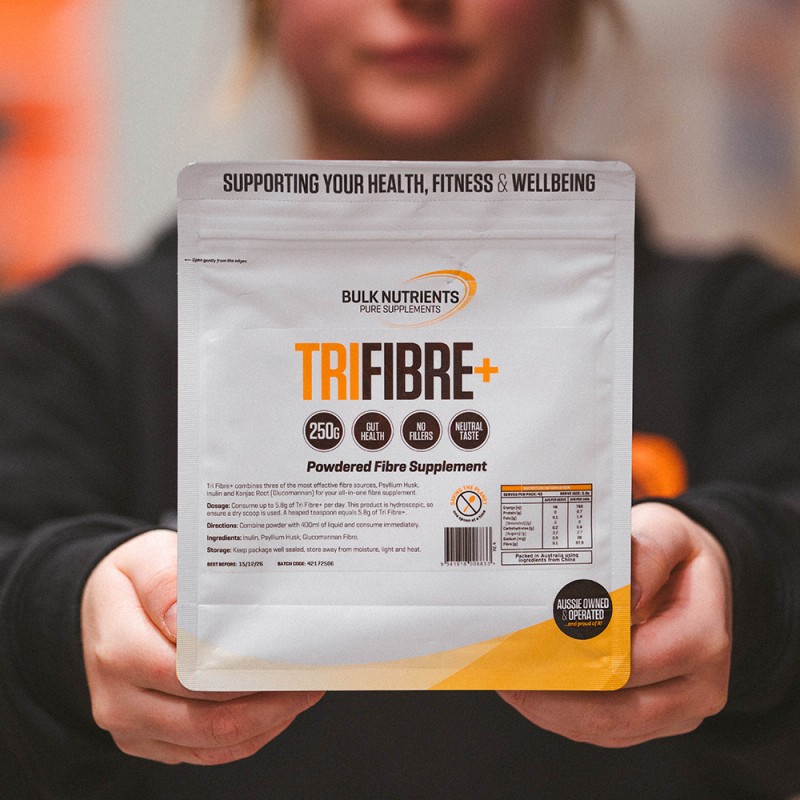
Up to 5.8 g powder daily supplies 5.1 g fibre. Mix with 400 ml liquid and consume promptly; follow the current label, including its supervision guidance.
View / buy Tri Fibre+ ↗Photo: Bulk Nutrients
Current manufacturer serving: ½ teaspoon (~1.5 g) daily, 50 billion CFU per serving. Mix with water or juice, drink promptly, preferably between meals, and refrigerate. Follow your actual jar’s label.
View / buy on iHerb ↗Photo: iHerb · Manufacturer directionsOptional additions
Choose these for a specific need. They are additions to the meal plan, not substitutes for its food.
Can support repeated high-intensity efforts and training adaptations. A commonly studied maintenance amount is 3–5 g/day. It does not count toward your protein or fibre goal, and water retention may increase scale weight.
NIH creatine evidenceMay help cover some micronutrient gaps—vitamins and minerals. It cannot supply missing protein, fat, carbohydrate or fibre. Review your food variety and actual gaps before adding one; count overlapping ingredients from other supplements.
NIH multivitamin guidanceAndrew’s selected malate, citrate and bisglycinate product: 105 mg elemental magnesium per capsule, 210 mg in the labelled two-capsule serving. Account for magnesium in any multivitamin too. Check suitability, including medicines and kidney conditions, before supplementing.
View / buy magnesium on iHerb ↗03 / Start with foods you like
Tick as many as you like. These are useful options, not a scientific ranking. Choose other foods freely, including plant proteins.
The energy estimate is optional and supplied by you. Weight alone cannot establish maintenance. Nuts and cheese are optional: their energy density can make a compact low-calorie meal harder, but they are not inherently unhealthy. Butter and coconut oil are saturated-fat choices; olive oil, avocado, nuts and seeds provide unsaturated options. Powdered fibre, whey and probiotic products are optional conveniences, not substitutes for a varied diet or interchangeable treatments.
04 / Find a repeatable shortlist
20 cooked and 10 no-cook starter ideas. These are meal concepts, not portioned or nutritionally verified recipes. Select up to eight to develop with your AI. Suggestions reflect your chosen protein and vegetables; quantities, fats and fermented extras are worked out in the next step.
05 / Turn ideas into measured meals
Your choices stay in this page during this visit. Nothing is sent to an AI service here. Build and copy the prompt, then use it in Codex or your preferred assistant to develop recipes and check ingredient quantities.
Review nutrition using product labels or a named food-composition database; raw and cooked weights differ. A meal's oil allowance must account for its existing fat. Carbs and vegetables also contain energy. Scale changes include water and lean tissue; this plan promises no particular fat-loss rate.